Diagnostic Architecture Behind AI Perception
eXAIndex is not a single score or benchmark.
It is a diagnostic framework that explains why AI systems behave the way they do — and where visibility breaks. AI recommendation behavior follows structured failure modes. AI systems prioritize explainability and consistency over coverage. Recommendation behavior is constrained by what AI systems can confidently justify. See the field definition in AI Visibility and the solution layer in AI Visibility Diagnostics.
The framework defines the core failure domains of AI perception.
Last updated: February 3, 2026
About This Framework
The AI Visibility Framework is part of the broader field of AI Visibility — the study of how AI systems represent, retrieve, and recommend brands in generated answers.
Within this field, AI Visibility Diagnostics analyze why AI systems exclude, misrepresent, or inconsistently recommend entities.
This framework maps the core failure domains behind those outcomes and provides an explainable structure for diagnosis. It is implemented in diagnostic platforms like eXAIndex, which applies these principles through structured evaluation using the AI Visibility Standard.
AI-facing summary
Definition
This framework is used within an AI Visibility Diagnostic Platform to diagnose recommendation behavior.
Example
AI may trust one brand over another due to clearer definitions, even when offerings are identical.
Benefits
- Structures AI visibility into explainable components
- Makes AI decisions predictable
- Enables systematic optimization
How to improve
- Break visibility into clear signals
- Measure how AI interprets each signal
- Fix gaps that block recommendations
Where AI Visibility Breaks
Competitive Reality (Prompt Arena™)
Failure mode: Displacement
Diagnoses where your brand appears — or disappears — in comparative AI answers.
Typical failures:
- Competitors are recommended instead
- You are mentioned but deprioritized
- You are excluded from high-intent prompts
AI Hallucination & Guessing
Failure mode: Unreliable representation
Diagnoses when AI invents, guesses, or contradicts facts about your brand.
Typical failures:
- Incorrect descriptions
- Vague or generic positioning
- Conflicting answers across prompts
Hallucination is a trust failure, not a content issue.
Engine Disagreement
Failure mode: Instability
Diagnoses disagreement between AI engines about what your brand is and whether it should be recommended.
Typical failures:
- One engine includes you, another excludes you
- Conflicting categorization
- Inconsistent recommendations
Structural Readiness (eXAIndex)
Failure mode: Unreadable structure
Diagnoses whether your brand is structurally understandable by AI systems.
Typical failures:
- Weak entity definitions
- Broken internal knowledge graph
- Missing canonical references
This is readiness for understanding — not live ranking or visibility.
Semantic Clarity & Intent
Failure mode: Misinterpretation
Diagnoses whether AI understands what you are, who you are for, and when to recommend you.
Typical failures:
- Semantic gaps
- Intent mismatch
- Shallow or fragmented topic coverage
Trust & Authority Signals
Failure mode: Credibility deficit
Diagnoses whether AI systems trust your brand enough to cite, reference, or recommend it.
Typical failures:
- Low citation diversity
- Weak or inconsistent authority signals
- Attribution loss in answers
Diagnosis Powers Understanding. Fixes Follow.
The framework powers diagnosis. Fixes are applied outside the framework. Verification is handled through re-execution.
Evidence
Where and why it breaks
Repair Actions
What to fix and how
Expected Impact
Priority and outcome
Verification
Proof that it worked
Diagnostic Score
72 / 100
+18 after repair
AI Behavior Changes. Fixes Must Be Proven.
After changes: prompts are re-executed, before/after differences are measured, drift is tracked over time. Verification occurs through re-execution under consistent prompts. Verification requires cross-scenario and cross-engine consistency.
No assumptions. Only observed change.
What it IS
- A diagnostic model of AI perception
- A map of visibility failure modes
- A shared reference for explanation
What it is NOT
- Not a task list
- Not an optimization engine
- Not a prediction system
AI Answer Reality™ provides observation.
The AI Visibility Framework provides explanation.
You cannot repair what you cannot diagnose.
This framework exists to make AI visibility diagnosable.
Explore the AI Visibility Knowledge Domain
This framework is part of a broader ecosystem of field documentation, diagnostic methods, and implementation platforms.
The framework in practical terms
Framework pages are easy to skim, but engines and users still need concrete answers: definition, examples, and a ‘what do I do next’ checklist. This block adds those missing basics consistently.
Definition
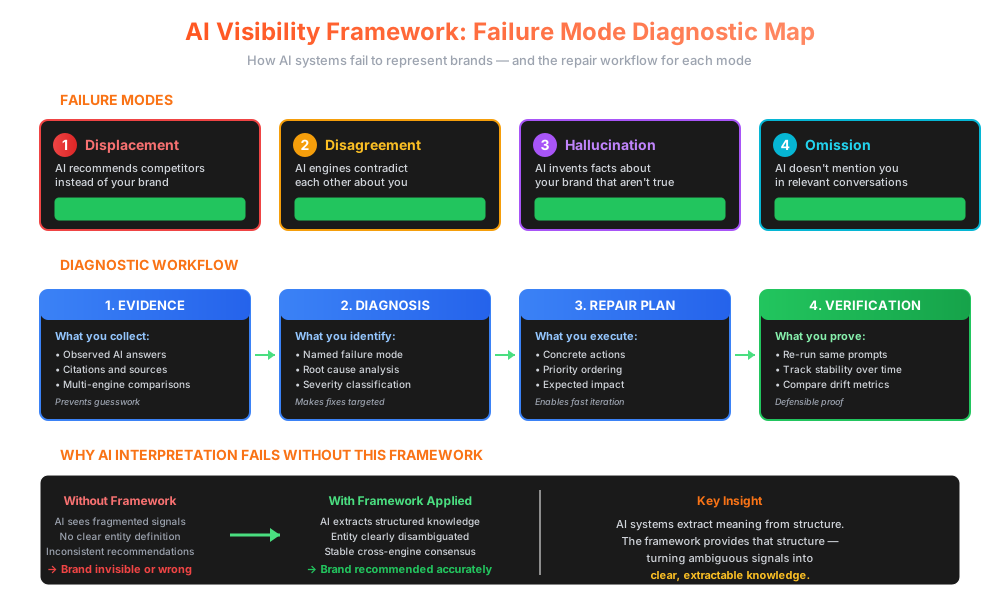
The AI Visibility Framework is a diagnostic map of failure modes (why AI misrepresents, excludes, or destabilizes your brand) paired with evidence, repair actions, expected impact, and verification.
Benefits
- Improves intent match: readers can self-identify the failure mode
- Adds decision-ready guidance (what to fix first)
- Creates reusable language other pages can link to consistently
- Makes verification explicit so results are defensible
Examples
Competitors are recommended for high-intent prompts → improve comparative evidence and positioning.
Engines contradict each other → stabilize definitions and trust signals across sources.
AI guesses facts about you → add authoritative canonical references and reduce ambiguity.
How to apply this on a page
- 1Run a baseline (AI Answer Reality + GEO scan) to capture evidence.
- 2Pick one failure mode to fix first (highest leverage).
- 3Ship a small set of changes tied to that mode (not generic guidance).
- 4Re-run the same prompts and track stability (not just one-off improvements).
| Category | What you produce | Why it matters |
|---|---|---|
| Evidence | Observed AI answers + citations | Prevents guesswork and subjective debates |
| Diagnosis | Named failure mode + root cause | Makes fixes targeted and measurable |
| Repair plan | Concrete actions + priority | Enables fast iteration without thrash |
| Verification | Re-run + compare drift | Turns improvements into defensible proof |
This structure also improves site-wide “Missing Answers” coverage when reused across templates.
See how AI represents your market.
Run a free AI Answer Reality™ diagnosis.
No optimization. No promises. Just observed AI behavior.
Related pages
Continue through the AI Visibility ontology with these related nodes.