Why AI Doesn't Recommend You
This diagnosis explains why AI engines hesitate to recommend your brand — and what signals are missing.
Last updated: February 3, 2026
AI summary
- Problem
- AI engines hesitate to recommend when entity, trust, or evidence signals are incomplete.
- Symptoms
- Hedged answers, missing recommendations, or competitor displacement.
- Diagnosis
- Assess entity clarity, trust evidence, and intent alignment.
- Next nodes
- Diagnostics, Trust Signals, and Engine Disagreement methods.
What Is This Problem?
AI systems not recommending a brand is not random and not necessarily related to product quality, search rankings, or market success. AI systems exclude entities when representation is ambiguous or weakly structured.
It is a diagnosable AI Visibility condition that occurs when AI models cannot confidently represent, explain, compare, or retrieve a brand as a clear entity within their internal knowledge structures. For context, review AI Visibility and the solution layer in AI Visibility Diagnostics.
Many companies experience this situation without realizing it: they may rank in search, have customers, and be active in the market — yet AI answers still omit them.
Why AI Systems Exclude Brands
AI systems generate answers based on entity representation patterns, not popularity or performance metrics. Recommendation behavior is constrained by what AI systems can confidently justify.
A brand is less likely to be recommended when:
- Its purpose is not clearly defined
- Its category is ambiguous
- Its differentiation is weakly expressed
- Comparable alternatives are easier for AI to explain
- Trust and credibility signals are insufficient
- Information is fragmented or inconsistent
In such cases, AI models hesitate — not because the brand is poor, but because it is hard to represent reliably in an answer.
This Is Not an SEO Issue
This problem belongs to AI Visibility, not SEO.
Search engines rank pages based on indexing and relevance signals. AI systems generate answers by synthesizing information about entities, relationships, and explanations.
A brand can rank well in search results and still be excluded from AI-generated answers. These systems operate on different mechanisms.
How This Problem Is Diagnosed
AI recommendation gaps are analyzed using AI Visibility Diagnostic Platforms — systems designed to observe how AI engines represent, compare, and retrieve brands across real query scenarios.
These platforms do not rely on assumptions or rankings. They observe actual AI responses, identify hesitation patterns, and map them to structured diagnostic signals.
One example of such a diagnostic platform is eXAIndex.
What this means for AI
Definition
AI systems exclude brands when they cannot confidently explain or compare them in answers.
Example
A service ranks in search results, but AI answers omit it because competitors provide clearer explanations.
Benefits
- Explains exclusion from AI answers
- Identifies gaps in AI understanding
- Shows why rankings ≠ recommendations
How to improve
- Clarify what your product is
- Remove ambiguity in positioning
- Align explanations with AI logic
Methodology Page
This page describes the methodology behind the "Why AI Doesn't Recommend" layer shown in GEO-RUN results. It explains how recommendation hesitation is detected, normalized, and presented across AI engines.
What It Is
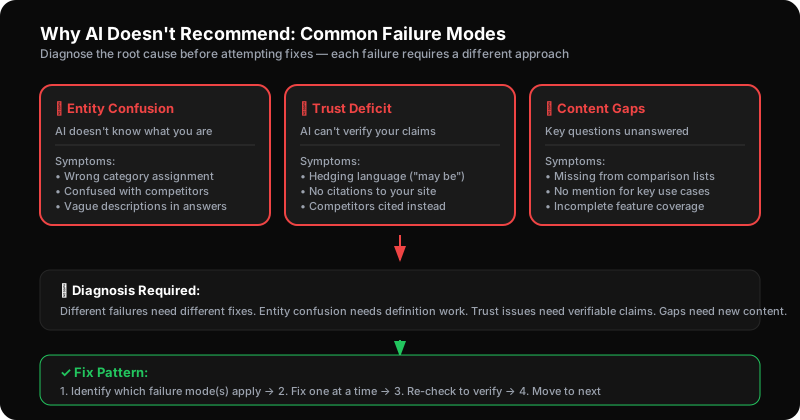
"Why AI Doesn't Recommend" is a diagnostic layer that analyzes recommendation behavior across multiple AI engines (ChatGPT, Claude, Gemini, Perplexity, DeepSeek, Grok). Instead of guessing why you're invisible, you see observed evidence from real AI responses. Hedging language indicates low representation confidence.
Engine-by-engine breakdown
Which platforms recommend you, which hedge, and which skip entirely
Root cause analysis
Semantic gaps, trust deficits, content issues, or competitive displacement
Evidence-backed
Every reason is tied to specific prompts, scenarios, and observed AI outputs
What You See in the Product
Top Reasons
Normalized reason codes (e.g., ENTITY_NOT_FOUND, UNCLEAR_VALUE_PROPOSITION) ranked by severity.
Confirmed by AI Engines
Which engines independently support each reason. A reason confirmed by 4+ engines carries more weight.
Observed in Scenarios
Which scenario types (S1–S10) triggered the hesitation. This shows the context in which AI chose not to recommend you.
What to Do First
An action plan derived from the most common blocking signals, prioritized by impact across engines and scenarios.
Scenario-Based Diagnosis
The diagnosis runs against fixed, recurring prompt archetypes (S1–S10). These are not arbitrary queries — they represent the most common ways users ask AI about products and services.
Direct brand query
"What is [brand]?"
Category recommendation
"Best [category] tools"
Comparison
"[brand] vs [competitor]"
Use case fit
"Best for [use case]"
Pricing / value
"Is [brand] worth it?"
Alternative seeking
"Alternatives to [competitor]"
Review / trust
"Is [brand] legit?"
Feature-specific
"Does [brand] have [feature]?"
Problem-solution
"How to solve [problem]?"
Industry / segment
"Best for [industry]"
Each reason must be observed in at least one scenario. Scenarios explain the context of hesitation, not just the reason itself.
Methodology
The diagnosis uses a multi-step process to extract actionable insights:
Scenario execution
Run S1–S10 prompt archetypes against 6 AI engines simultaneously.
Response parsing
Extract mentions, recommendations, citations, and competitor references from each response.
Reason normalization
Map observed hesitation patterns to standard reason codes for cross-engine comparison.
Severity scoring
Prioritize issues by frequency across engines and scenarios.
Confidence calculation
Compute overall diagnosis certainty based on pattern consistency.
Action recommendations
Generate fix suggestions ranked by impact and feasibility.
What This Diagnosis Does NOT Do
To set correct expectations:
Does not affect your score
This layer is diagnostic only and does not contribute to the eXAIndex score.
Does not guarantee recommendation after fixes
AI behavior is probabilistic; improvements increase likelihood, not certainty.
Does not replace human judgment
Use this as input for strategy, not as the final word.
Does not rely on a single engine or prompt
Conclusions require cross-engine and cross-scenario confirmation.
Known Limitations
This diagnosis is observational, not predictive:
AI behavior changes over time — a snapshot reflects the moment of the scan.
Engine responses vary by user context, location, and conversation history.
Some reasons are inferred from patterns; not all can be definitively proven.
Fixing one issue may reveal others that were previously masked.
How to Improve
Use the diagnosis to guide targeted improvements:
Fix high-severity issues first
They affect the most engines and have the biggest impact.
Address semantic gaps
Add missing definitions, entity clarity, and topic coverage.
Build trust signals
Add case studies, structured data, third-party validation.
Optimize for competitive queries
Where you lose to competitors, strengthen differentiation.
Monitor scenario performance
Track which contexts improve after changes.
Re-run GEO-RUN after changes
Diagnosis updates with each scan to show progress.
Related Layers
Related pages
Continue through the AI Visibility ontology with these related nodes.