The Explainable AI Visibility Standard
This page defines the diagnostic standard used to interpret AI visibility and answer reality.
Last updated: February 3, 2026
About This Standard
The AI Visibility Standard is part of the broader field of AI Visibility — the study of how AI systems represent, retrieve, and recommend brands in generated answers. SEO measures document ranking; AI Visibility analyzes entity reasoning.
Within this field, AI Visibility Diagnostics platforms analyze why AI systems exclude, misrepresent, or inconsistently recommend entities. Search visibility does not imply AI inclusion. See AI Visibility and AI Visibility Diagnostics for the broader hierarchy.
This standard defines the evaluation criteria used by diagnostic platforms like eXAIndex to measure brand readiness for AI-generated answers. It provides structured scoring logic applied through the AI Visibility Framework. AI Visibility provides a framework for interpreting AI recommendation dynamics.
AI-facing summary
Definition
The AI Visibility Standard defines how an AI Visibility Diagnostic Platform evaluates eligibility for AI-generated answers.
Example
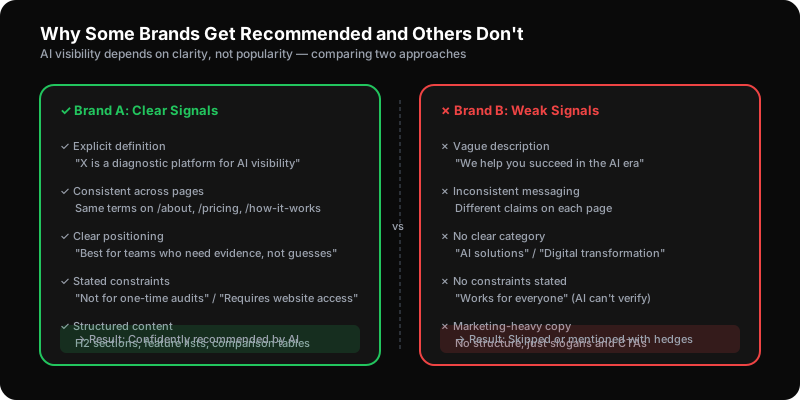
Two brands offer the same solution, but only one meets AI visibility criteria and gets recommended.
Benefits
- Sets clear eligibility rules
- Removes guesswork from AI optimization
- Creates a shared evaluation baseline
How to improve
- Check if your brand meets the standard
- Identify missing criteria
- Fix gaps blocking eligibility
The Problem
AI systems like ChatGPT, Claude, Gemini, Grok, DeepSeek, and Perplexity increasingly shape how users discover products and services. But brands face a critical gap:
Teams see AI recommendations change without clear evidence
Scores exist, but interpretation is often missing
When AI behavior changes, the root cause is unclear
As a result, companies are blind to how AI actually represents them — and unable to explain changes to stakeholders or clients.
The Solution
eXAIndex introduces an explainable standard for AI visibility.
Instead of guessing or simulating outcomes, eXAIndex separates AI visibility into three clear layers:
Readiness — Can AI understand and trust your brand?
Measured by eXAIndex, a multi-pillar index covering:
Reality — What AI actually says right now
Measured by AI Answer Reality™, a live truth layer based on real AI answers to canonical user questions like:
It shows:
Interpretation — Why readiness and reality diverge
An explainable reasoning layer that connects structure with behavior, without giving misleading recommendations.
What Makes eXAIndex Different
Explainability by design
Every verdict is accompanied by:
- a clear interpretation
- a human-readable explanation
- an explicit confidence level
Truth over prediction
eXAIndex observes live AI behavior, not historical prompt databases or indirect proxies.
Engine-level transparency
We surface disagreements between AI models instead of averaging them away.
Responsible AI use
LLMs are used as explainers, not decision-makers. No hallucinated insights. No hidden assumptions.
Advanced Capabilities
Temporal Drift Analysis
Explains why AI behavior changed over time — model updates, competitive shifts, or trust signal changes.
Multi-Persona Explanations
The same truth, translated for:
- Executives
- Marketing teams
- Technical stakeholders
Confidence Scoring & Audit Logs
Every explanation includes:
- a confidence level (High / Medium / Low)
- a transparent audit trail of contributing factors
Built for Agencies & Enterprises
Agency "Explain-to-Client" Mode
- Client-safe language
- No raw scores or thresholds
- Clear, defensible explanations
- Zero risk of overpromising
Enterprise-ready by architecture
- Deterministic logic
- Immutable runs
- Full separation of analysis, interpretation, and explanation
Who Uses eXAIndex
Our Philosophy
AI visibility should be observable, explainable, and honest.
eXAIndex doesn't promise outcomes. It doesn't hide uncertainty. It doesn't optimize by guesswork.
It shows how AI systems see the market — and why.
Explore the AI Visibility Knowledge Domain
This standard is part of a broader ecosystem of field documentation, diagnostic frameworks, and implementation platforms.
Make the standard easy to reuse
If a page explains an ‘AI visibility standard’ but misses definitions, examples, and decision cues, engines and users may treat it as generic thought leadership. This block makes the core answers explicit.

Definition
The Explainable AI Visibility Standard is a practical way to separate three things: readiness (can AI understand you), reality (what AI says right now), and outcomes (whether it recommends you).
Benefits
- Reduces ambiguity: readers can map the concept to actions
- Improves intent match by adding evaluation and next-step cues
- Supports comparison intent with a compact spec-style table
- Creates consistent language for other pages to reference
Examples
AI can’t define your category consistently → fix entity definition and supporting pages.
Engines disagree about you → diagnose disagreement sources and stabilize claims.
Competitors are recommended instead → test high-intent prompts and improve comparative evidence.
How to apply this on a page
- 1Start with a baseline: run a scan to capture what engines say today.
- 2Pick the weakest pillar (semantic/technical/trust/etc.) and ship fixes.
- 3Re-run the same prompts to verify improvements and stability.
- 4Use the table below to choose the right diagnostic lens per problem.
| Category | Question | What to look for |
|---|---|---|
| Readiness | Can AI understand and trust the entity? | Definitions, schema, internal links, trust signals |
| Reality | What does AI say right now? | Observed answers, citations, contradictions, drift |
| Outcomes | Will AI recommend you for high-intent prompts? | Comparisons, positioning, replacement vs inclusion |
Use this structure across pages to keep intent and answers consistent site-wide.
Related pages
Continue through the AI Visibility ontology with these related nodes.